Parlium beta
Think differently. Test rigorously.
An AI thinking partner for exploring the scientific hunch you’re not ready to share — for testing it against the literature, and keeping what you find joined up.
Free while it is in beta. No password — we email you a link.
One question, followed through — a worked example from a real project
Night science
One — ExploreCreativity
Night science is one of Parlium’s two modes — there to stimulate creativity and to look at a difficult problem in new ways, drawing on the creative research practices taught by the Night Science Institute.
The question, arriving
Why is resistance to the drug inevitable?
The example, summarised
A lens changes the question.
Among the creative options Parlium offers is an unlikely one: the drug as a buy-one-get-one coupon that works so well the store keeps repricing. That picture opens a different question: is the tumour generating new escape routes, or drawing on ones that were already there?
See the full conversationHide full conversation
help me think about why osimerinib resistance is inevitable in NSCLC
“Okay, let me push on that word — inevitable. Is that your belief from the data, or the field’s assumption you’ve inherited? Because they lead somewhere different.
Here’s a probably-wrong thought: we call resistance inevitable because we keep asking ‘how does resistance emerge?’ — which presumes it will. Flip it: why hasn’t the tumour already solved resistance by the time treatment starts? What’s stopping it?”
[Parlium has offered a few ways of looking at the problem, as cards beside its reply. The researcher presses one, and the press sends it:]
through A buy-one-get-one coupon that works so well the store switches the price weekly.
Look at the problem through this picture, and tell me what it turns up.
A buy-one-get-one coupon that works so well the store switches the price weekly.
Each escape route the drug closes reveals the next unguarded exit.
Sit with the coupon a second — who set that rule? The store keeps changing the price, but the coupon only ever works one way: buy, get one. The drug’s escape logic is fixed — kill EGFR-dependents, and whatever’s left grows. It never invents a new rule, it just reruns the old one on whoever survives.
So maybe the question isn’t “which exit next?” but: does the tumour have a generator of new exits, or just an inventory of pre-existing ones being exhausted one by one? If it’s inventory — a finite list of pre-wired alternatives — then “inevitable” means something quite different than if it can improvise.
Which does your gut say — warehouse or workshop?
Day science
Two — TestRigour
Day science mode takes an idea you’ve been playing with, tests it against the literature, and finds related research already being funded.
Parlium searches both: PubMed, Semantic Scholar and bioRxiv for papers; NIH, Wellcome, Cancer Research UK, the MRC, the ERC and forty more for awards.
Already have a library? Import it from Zotero.
The question, sharpening
Is something generating the escape routes?
The example, summarised
The evidence changes the question.
The literature supports two possibilities: resistant cells can already be present, and resistance can also evolve during treatment. The next question becomes: how much does each route contribute, and what evidence would distinguish them?
See Parlium’s full responseHide full response
Verdict: the literature says it’s both — and more importantly, that the two are connected. I saved five papers and linked each to your idea. Here’s the test result:
Evidence for the inventory (pre-wired exits)
- Chabon et al. (2016), Nature Communications — CAPP-Seq ctDNA in EGFR-TKI–treated NSCLC found multiple resistance mechanisms co-existing within the same patient at progression, and pre-existing T790M + MET amplification together predicted inferior response. That is exactly what a finite repertoire being sampled/revealed looks like: the exits were built before the drug arrived.
- Supporting clinical texture from the review literature (Leonetti 2019; Gomatou 2023): resistance mechanism frequencies differ between first-line and second-line osimertinib — consistent with different selection pressures fishing different fish out of a pre-existing pond.
Evidence for the generator (improvisation)
- Hata et al. (2016), Nature Medicine is the key paper. It shows T790M resistance arises both by selection of pre-existing clones and by de novo genetic evolution from initially T790M-negative drug-tolerant cells — and the path matters: de novo-evolved clones have blunted apoptotic responses to third-gen TKIs, reversible with navitoclax. So the routes aren’t equivalent, and the distinction is biologically legible.
- Selenica et al. (2022), Annals of Oncology: APOBEC-dominant signatures are enriched in mutations found only in post-osimertinib samples (44% vs 23% pre-treatment), with kataegis and large rearrangements. Osimertinib pressure appears to actually upregulate a mutagenic engine producing new private alterations — a literal generator running hotter under therapy.
- Adua et al. (2022), Nature Communications: RhoA/SRF “poised” subpopulations in the brain metastasis setting are pre-existing and adaptive — the resistance state is partly wired, partly induced by the niche (laminin, brain TME).
The synthesis the literature pushes toward
The persister framework (Choi et al. 2026, Cells — review, and note preprints/abstracts from AACR in this space) argues inventory and generator are not alternatives but stages of one trajectory: heterogeneous pre-adaptive states → reversible drug-tolerant persister (DTP) cells → genetically stabilised clones. The DTP is the bridge — it’s how a generator’s output gets written into the inventory. Hata’s two paths map onto this: pre-existing selection (inventory) vs DTP-sourced evolution (generator via persister).
Caveats: most of the DTP/plasticity work is in cell lines and PDX models; the APOBEC result is association from panel sequencing, not demonstration that APOBEC generates the resistance mutations themselves; and no study I found has formally quantified the fraction of clinical resistance that is selection vs de novo per mechanism — which is exactly the experiment your dichotomy implies (deep pre-treatment sequencing + longitudinal ctDNA + mutational signature attribution).
The honest answer to “does it improvise?” is: yes, but the improvisation runs through pre-existing persister states, and it tends to land on a surprisingly convergent set of exits (C797S, MET amp, transformation) — so the generator has strong biases toward the same few solutions.
The paper, rebuilt to be read.
Three — Read
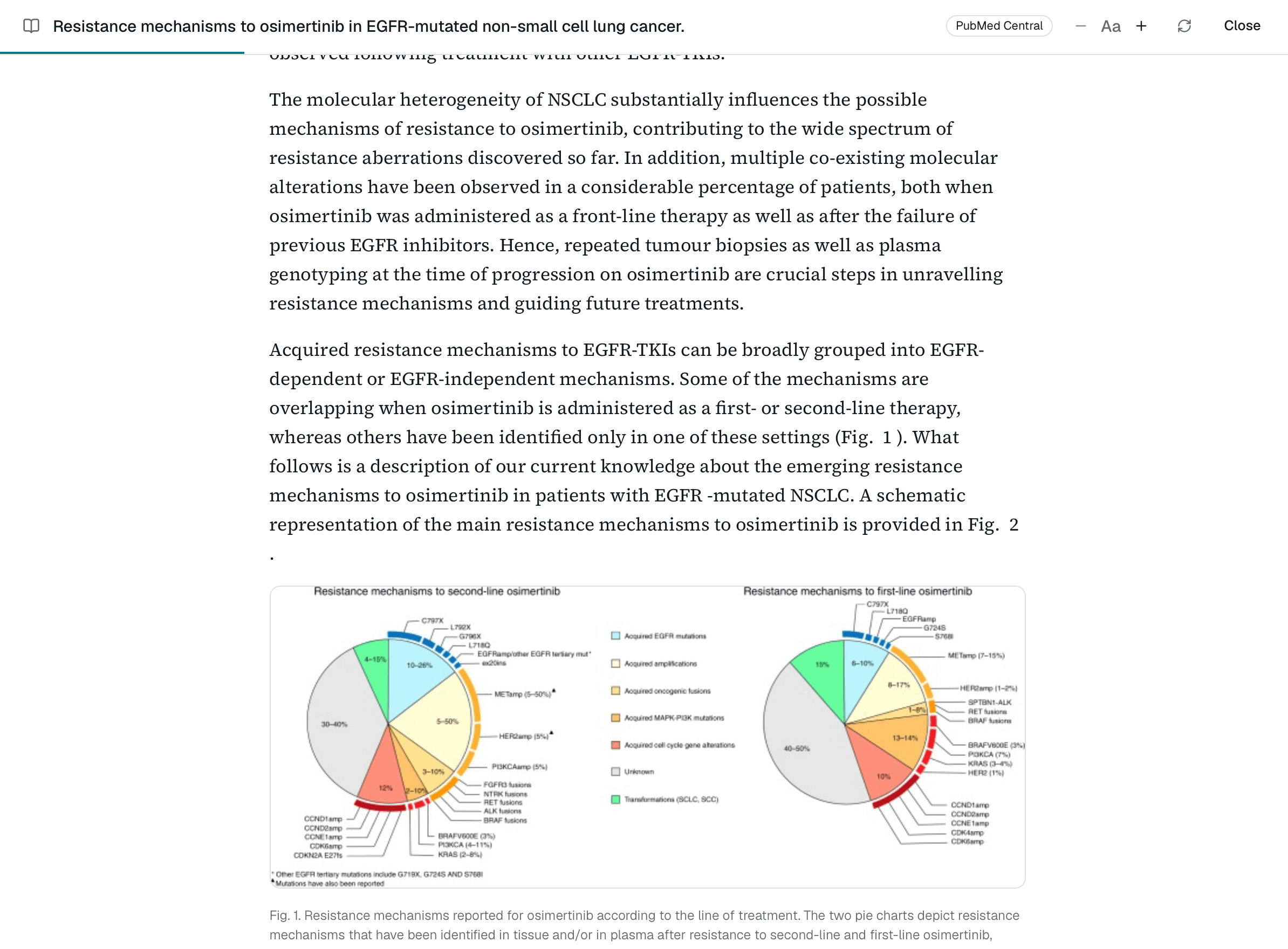
Not the publisher’s two-column PDF. Where there is an open-access copy, Parlium rebuilds the whole paper as one readable column — figures, tables and equations intact. Select a passage that strikes you and keep it as an idea.
The question, under test
What evidence distinguishes resistance that was already present from resistance that evolved during treatment?
Four — Map
Not a chat log.
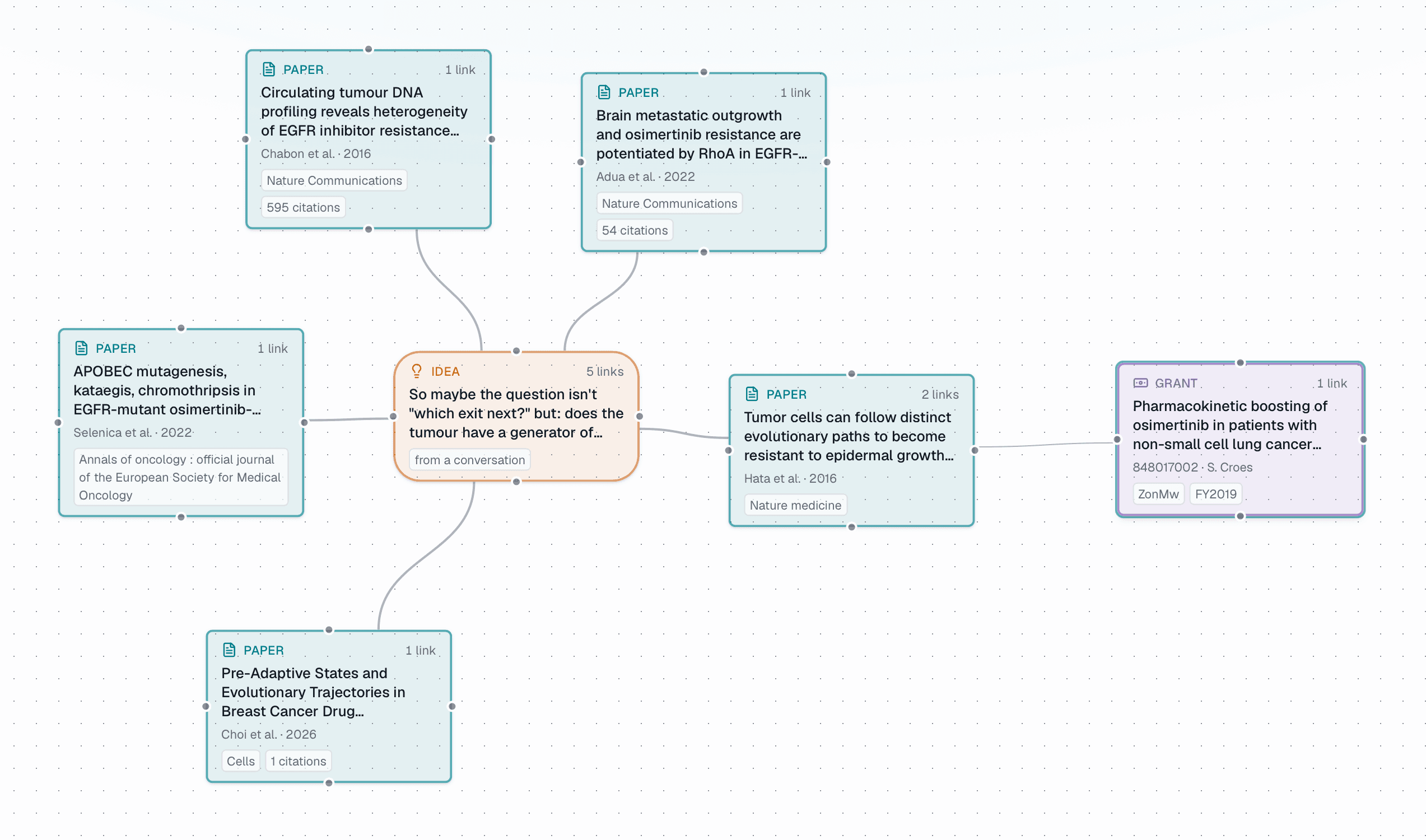
What you find is kept with the idea — which papers support it, which ones argue against it, and why. It is all still there when you come back.
Started with
Why is resistance to the drug inevitable?
Where it landed
How much resistance was already present, how much evolved during treatment — and how could we tell?
Joined to five papers and a funded grant, with the reasons written on the links — all of it below.
Explore, test, read, map — and then round again, with what you found.
Parlium is built for both halves of science — creativity and rigour.
Get started